Monthly bench press routines may result in plateaued progress or shoulder fatigue, and dumbbell variations are added without a specific plan. Workout logs track sets and weights, but they may not include deload phases, scapular positioning, or post-workout nutrition timing, which can affect muscle adaptation and recovery. Discover how to alternate bench press and dumbbell bench press by planning weekly intensity waves, choosing shoulder-safe grip widths, and scheduling sleep, so chest training becomes a sustainable approach for building strength.
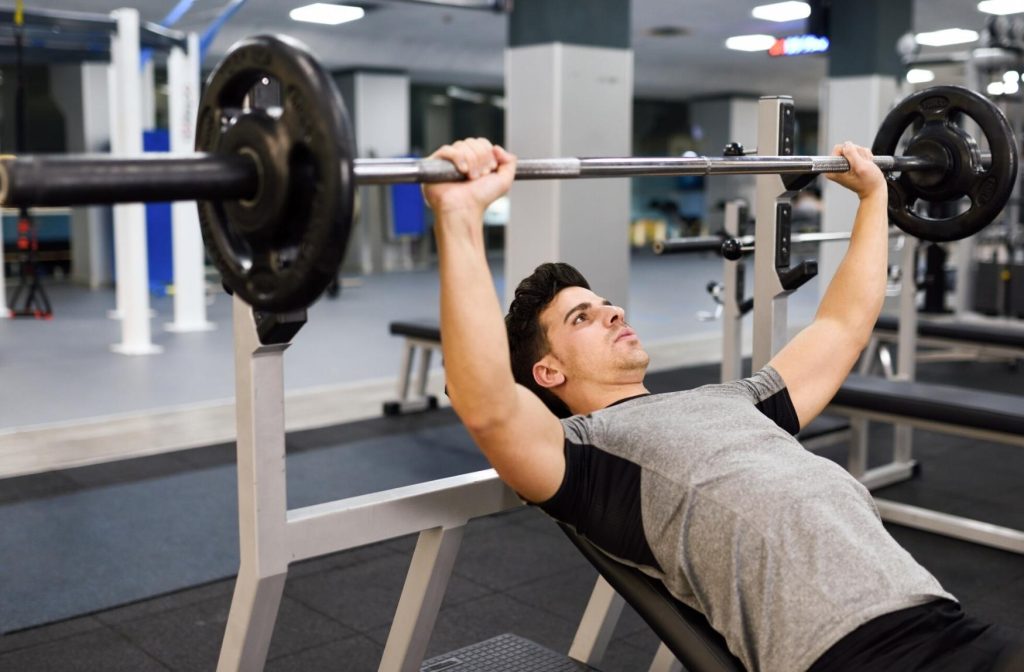
Hybrid Periodization: Cycling Barbell and Dumbbell Phases
Sticking to one pressing variation leads to plateaus and joint wear over time. A smarter approach alternates between barbell-focused strength blocks and dumbbell-focused hypertrophy blocks. This rotation keeps the nervous system responsive, spreads mechanical stress across different joint angles, and delivers both raw power and muscular detail.
Barbell strength phase RPE 8 to 9, 3 to 5 reps
During this 4-week block, the workout centers on heavy barbell bench press with low repetitions and high load. The goal is neural adaptation: teaching the central nervous system to recruit more muscle fibers simultaneously. Sets of 3 to 5 reps at RPE 8 to 9, meaning 1 to 2 reps left in reserve, build maximal strength without excessive muscle damage. Rest intervals stretch to 3 to 5 minutes to allow full ATP replenishment. This phase improves the lifter’s ability to handle heavy weights, which directly translates to heavier dumbbell loads in the next block.
Dumbbell hypertrophy phase 8 to 12 reps with 3-second eccentrics
The following 4 weeks shift to dumbbell bench press with moderate weight and higher repetitions. Dumbbells allow a deeper stretch at the bottom and a tighter contraction at the top because each arm works independently. The 8 to 12 rep range maximizes time under tension and metabolic stress, driving muscle fiber growth. Rest intervals shorten to 60 to 90 seconds. Crucially, each rep includes a 3-second controlled negative phase. The dumbbells should lower until the upper arms reach parallel to the floor, but not beyond the natural tension limit of the chest and front shoulder capsule. Excessive lowering past shoulder depth shifts stress to the anterior capsule and reduces the mechanical advantage of the press.
Wave loading and RPE-guided progression
Each 4-week block uses wave loading: week 1 is moderate, week 2 is heavier, week 3 is peak intensity, and week 4 is a deload with reduced volume and weight. Progression decisions rely on RPE rather than fixed percentages. If the prescribed weight feels like RPE 9 on week 2, the lifter does not add weight on week 3. If it feels like RPE 7, the lifter adds 2.5 to 5 pounds. This auto-regulation prevents pushing too hard on bad days and under-training on good days.
Scapular Lockdown and Unracking Mechanics: The Setup That Prevents Pain
The bench press and dumbbell bench press share a common injury mechanism: shoulders rolling forward during the push. The fix lies entirely in the setup before the first rep, and the most critical moment is the unrack.
Retract and depress the scapulae
Lie on the bench and consciously pull the shoulder blades down toward the hips and together toward the spine. This action creates a stable shelf on the bench. The upper back remains tight throughout the entire set, with the chest lifted and the ribs expanded. Once the scapulae are locked, they do not move during the press.
Pull the bar out with lats, do not press it out
The unrack destroys more setups than any other moment. Many lifters press the bar upward off the pegs as if performing an overhead press. This action pushes the shoulders forward and unseats the scapulae. The correct method uses the lats to pull the bar horizontally out of the pegs while keeping the shoulders pinned back. The lifter squeezes the armpits, engages the lats, and drags the bar out of the j-hooks. The bar then settles over the shoulders in the starting position with the scapulae still fully locked.
Elbow angle 45 to 70 degrees, never 90
The elbow angle relative to the torso determines shoulder safety. A 90-degree perpendicular flare places the humeral head directly under the acromion, compressing the supraspinatus tendon with every rep. Maintaining a 45 to 70 degree angle between the upper arm and the torso keeps the shoulder in a more stable mechanical position. The lifter thinks about tucking the elbows slightly toward the ribs on the descent, then flaring them back out as the bar reaches the chest. This subtle adjustment prevents chronic impingement.
Nutrition and Creatine Timing: Fueling Explosive Pressing
Heavy pressing relies on the ATP-phosphocreatine system for immediate energy. Supporting this pathway requires consistent creatine supplementation and strategic carbohydrate intake around training sessions.
5 grams of micronized creatine daily, no loading phase
Creatine saturation occurs through steady daily accumulation, not a rapid loading protocol. Taking 5 grams of micronized creatine monohydrate every day maintains full muscle stores after roughly 3 to 4 weeks. The micronized form dissolves easily in water or juice and avoids the digestive discomfort associated with lower purity versions. There is no need to front-load with 20 grams per day for a week; that old protocol causes bloating and provides no advantage over the daily 5-gram approach.
Specific carb sources: white rice, glucose powder, or pre-workout blends
Fast-digesting carbohydrates 30 to 60 minutes before training elevate blood glucose for immediate energy. Practical sources include cooked white rice, glucose powder mixed with water, or commercial pre-workout powders that contain dextrose or maltodextrin. Aim for roughly 30 grams of carbs from one of these sources. Post-training, the same amount paired with 20 to 30 grams of protein from whey or whole food accelerates glycogen resynthesis. White rice with chicken breast or a whey shake with added dextrose are straightforward real-world options.
Practical carb timing in daily life
The pre-workout meal should sit 60 to 90 minutes before the first rep to allow digestion. A bowl of white rice with a small protein serving fits this window. For morning lifters who train fasted, glucose powder dissolved in water provides a quick-acting alternative that does not require full digestion. The key is having fuel available before the phosphocreatine system depletes mid-set.
Sleep and Recovery: The Overlooked Growth Phase
Heavy pressing causes microscopic tears in the muscle fibers. These tears do not repair during the workout; they repair during deep sleep. Without sufficient sleep, recovery stalls and fatigue accumulates.
Seven and a half to nine hours target
Sleep research consistently shows that lifters who average 7.5 to 9 hours of uninterrupted sleep recover faster than those who sleep less. The difference appears in the ability to repeat the same weight on the next session. Well-rested lifters often add weight weekly, while sleep-deprived lifters plateau or regress. The mechanism involves growth hormone peaks during slow-wave sleep and REM consolidation of motor patterns.
Deload weeks and active recovery
On non-pressing days, light cardio or mobility work increases blood flow to the chest and shoulders without adding mechanical stress. During the fourth week of each 4-week block, the deload phase reduces pressing volume by 50 percent, allowing connective tissues to catch up to muscle adaptations. These scheduled recovery periods are integral to the periodization plan, not optional extras.
Conclusion: Structuring Pressing Progress with RPE and Mechanical Control
Optimizing long-term pressing gains requires structuring your training into dedicated strength and hypertrophy blocks while strictly enforcing joint-protective mechanics. Rotate between 4-week barbell strength cycles (RPE 8 to 9, 3 to 5 reps) and dumbbell hypertrophy phases (8 to 12 reps with a 3-second eccentric tempo), ensuring you pull the bar off the pegs using your lats to prevent unseating your retracted scapulae. Pair this progressive overload with daily 5g micronized creatine, targeted intra and post-workout carbs, and 7.5-plus hours of sleep to sustain nervous system recovery and protect the rotator cuff from chronic overuse.